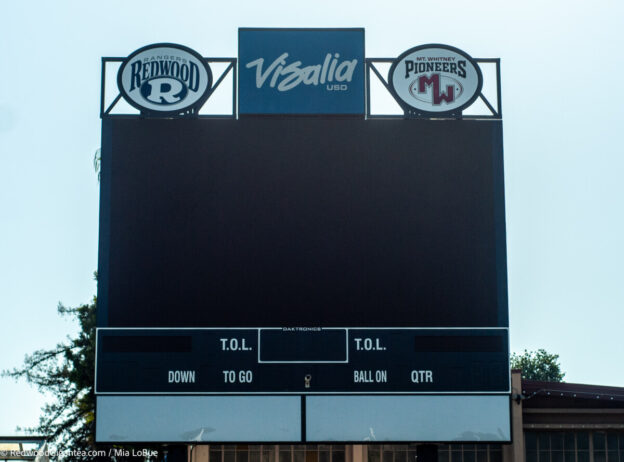
While the new scoreboard enhances the fan experience, athletes say it has introduced added pressures and new changes behind the scenes.
By: Ariana Lopez Salguero and Adriana Soria-Rosales
When fans return to the stadium this spring, the most noticeable change will be impossible to miss, a massive new scoreboard glowing above the field.
But for Athletic Director Michael Wright, the idea started long before construction crews ever stepped onto the field.
“It all started when I got here. I wanted a Jumbotron,” Wright said. “Schools like Orosi have a Jumbotron, Shafter, there are these little schools, and our scoreboard wasn’t even working. I’m like, this is kind of embarrassing for a school the size of us or a district like us.”
What began as a vision to elevate the program quickly turned into a complicated process. Wright initially worked to secure sponsorship funding and push the project forward, but progress was slow.
“There’s the state architecture that you have to go through to get approved,” he explained. “There’s different laws for earthquakes, wind shear, so it doesn’t blow over and hurt somebody. There’s a lot of building codes that it has to meet,” said Wright.
Even after finding a sponsor, setbacks followed. “I had already had it sold, but my person ended up passing away, so I lost that sponsorship,” Wright said.
Eventually, the district stepped in to take over the project, moving it through approvals and into construction.
That’s where project manager Jennifer Frederick came in.
According to Mrs. Frederick, what spectators will see is only a fraction of the work that has gone into transforming the venue. Mrs. Frederick, who oversees facilities projects for the district, played a central role in coordinating the upgrade.
“I work with the architect, the vendor, the contractor, and make sure it all gets done,” she explained, describing a job that requires balancing multiple moving parts behind the scenes.
While the installation may appear straightforward, Mrs. Frederick said the biggest challenge wasn’t technical; it was timing. “I think the biggest problem was scheduling because the stadiums are always busy,” she said. “So to shut it down was very difficult.”
Coordinating construction around games, practices, and school events required careful planning long before work began.
Despite the complexity, the transition from planning to construction happened quickly. “We shut down the bowl January 5th and construction actually started on the 6th, the very next day,” Frederick said.
Still, much of the effort went unnoticed. “There’s a lot of work that nobody sees because it’s in the press box or they’re pulling wire underground, so it’s hard to see the physical work being done.”
The timing of the project itself was no accident. District officials worked closely with athletic leadership to minimize disruption. “We talked with the director of the athletics department to determine what would be the least impactful on the students,” Frederick said.
That collaboration helped identify a window that balanced construction needs with athletic schedules.
The project is on a tight timeline, with construction scheduled to wrap up by May 1. After that, staff will have just a few weeks to prepare the system for its debut.” Once construction is done, the district is going to have a couple of weeks to figure out how to use the new system so that it will be ready by graduation,” she said.
When it goes live, the scoreboard will offer far more than just scores and game time. Frederick expects the experience to evolve, “this year, I think we’re going to have each site come up with prerecorded videos that can be played during halftime and timeouts,” she said. “Eventually, hopefully, we will be able to do replays.”
A field-level camera and expanded video capabilities could bring a more dynamic, professional feel to games, depending on how schools choose to use the technology.
Students will play a role in that future as well. Theater tech crews are expected to operate the video display, while traditional scoreboard functions will remain familiar. “It all depends on how much the schools and their different classes want to be involved,” Frederick noted.
And the scoreboard is only part of the transformation; a newly approved lighting upgrade will debut alongside it, adding LED systems capable of changing colors and creating dynamic effects. “Between those two projects, it is going to be a whole other level in our stadiums,” Frederick said.

By graduation, that behind-the-scenes effort will finally take center stage, lighting up the field, the stands, and a new level in tech for Redwood Sports will show in the stadium.
While the new system of the scoreboard adds a whole other level in Redwood sports for upcoming football and soccer seasons, frustrations are hard to ignore.
Some athletes are disappointed, especially those who competed in winter sports or are now in spring sports and depend on the bowl for practices and games but lost access during the project.
Redwood teacher and Track and Field coach Isaac Leppke has been holding practice at Mt Whitney High School.
Practicing at your rival school sometimes comes with challenges. “Sometimes you have to respect the drills that they’re doing as well so when we get there, we may not meet up in the areas we thought we’d like or there is space on the track that’s occupied so you have to be flexible,” said Coach Leppke. “You now have multiple options at practice, and you have to be ready to adjust your plan.”
With practices pushed to 5 p.m. and no direct access to the bowl, Coach Leppke is focusing on the positives: “It’s nice having that hour after school to step away, think about practice, and reset.”
“At first it was difficult starting at 5 p.m. because kids do have that hour break after school, that was only probably for a week or two at the beginning of the season,” said Coach Leppke. “Most of the kids have to walk to Whitney. The kids are used to it now, and parents have to get used to picking up their kids at later times.”
Coach Leppke thanked Mount Whitney’s athletic director for providing a sea-train container to store the team’s gear.
That also brings attention to the struggle of transferring a lot of the team’s stuff from Redwood over to Whitney. And then when the bowl opens, all that stuff that’s stored will have to be transported back.
Wyatt Ruby ‘27 is a three-year track and field athlete, and shares how the project has affected him personally and his season, “Well, pretty much all of my junior year of track, I’m not going to be able to use the bowl, excluding the very end of the season, maybe when I go to like, state or nationals.”
Ruby shared that he doesn’t feel it has been crowded except for at the beginning of the season, “Most of the Whitney track team is pretty cool, and even though we have like a football rivalry, with track it doesn’t exist as much, so we’re all pretty chill, at least from what I’ve experienced.”
The Mineral King Bowl closure had many negative effects on people, and Ruby shared his least favorite part, “Probably just the timing because they’re like ‘oh let’s do it right after football’, so then track and soccer and anybody else can’t use the bowl, obviously they’re [going to] play favorites, and that’s normal. It’s just a little bit annoying.”
Blake Duncan ‘28 played her second year on the varsity girls soccer team and is currently in her second year of varsity track and field.
Duncan shared, “It was a little sad not to be at [our] home field, but it was fun to play at other fields. I think next year, once we get our field back, it’ll be the way it used to feel.”
“It felt different than obviously playing [in the bowl], but once we started to play there more often, it felt like our new home field, but the bowl will always be our home.”
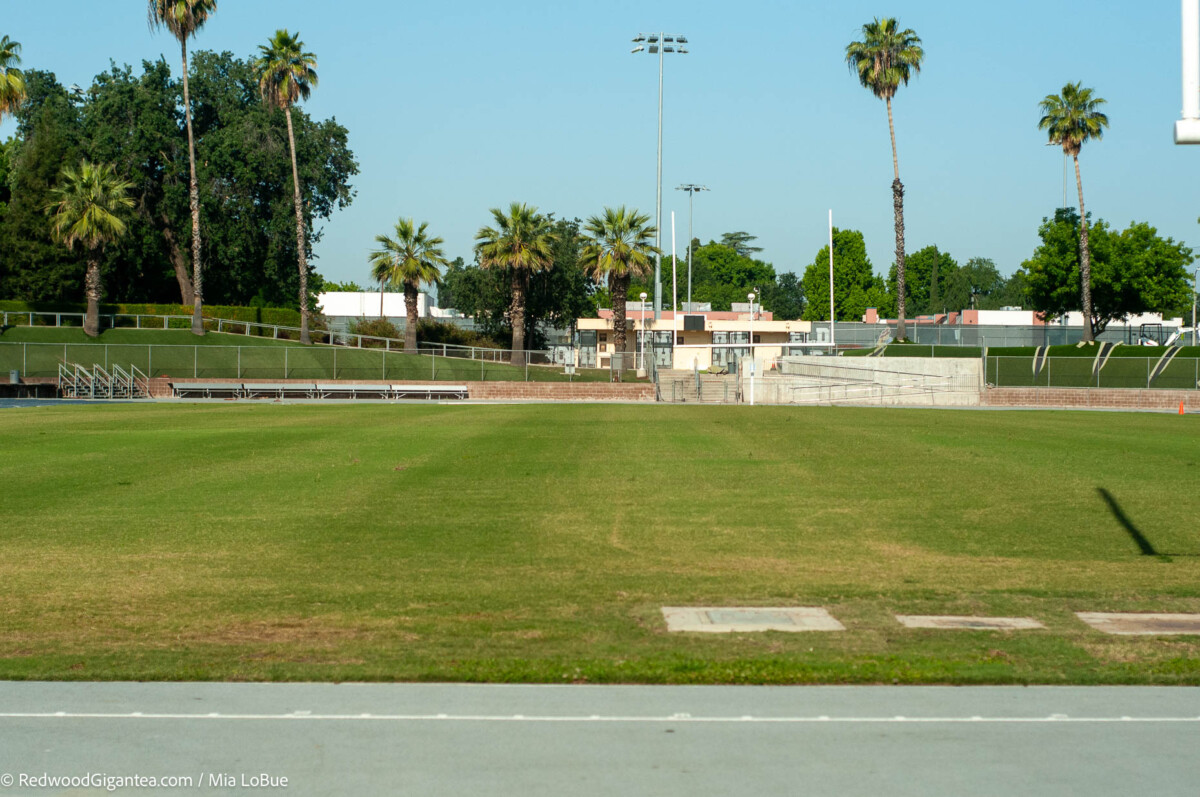
Photo M.LoBue/Gigantea
Head women’s soccer coach Jason Vieira said that the MKB project definitely affected fan turnout. “The home field we had [at Mt Whitney] doesn’t house that many people, so I’m sure some people stayed home.”
He said, “Families and parents are going to come no matter what, but I think like staff and students probably stayed home.”
Vieira shared how the atmosphere of playing in the bowl is: “Playing a home playoff game in the bowl is special, and the crowds are usually big, so the atmosphere is great. I don’t think it impacted the [season’s] results, though.”
Vieira said “I know [the girls] were sad, but I don’t feel like it ever carried over into how we played. I was proud of how resilient they were. They had the right attitude about it.”
Concerning the scoreboard project’s impact and timeline, Vieira said “It’s definitely frustrating, and I don’t think it’s the fault of anyone at Redwood. But the work on it didn’t start until January; we could have had quite a few home soccer games.”
“It does create a huge problem, not only for boys’ and girls’ soccer but for track, having to find places to train, because track does use the bowl as a practice facility too. I just feel like the timing of it could have been done a little bit differently.”
Cutler Griswold ’26, Redwood boys soccer goalkeeper, spent his last soccer season not being able to play in the Mineral King Bowl due to the improvements being done to the bowl.
His senior year, he said, “It was weird because I love playing in the bowl, it’s always been my favorite place to play. But at the same time, it was kind of a good experience because it prepared us for the playoffs, and we had to go away to every game. It was kind of a good and bad situation.”
Though the project brings complications for athletes, Griswold acknowledges the positives. He said, “Whitney’s grass is better, since it’s green and alive, they keep it nice, and they reseed it. So that was kind of nice, but their field is also a lot smaller, so we had to change our style of play a bit.”
To Griswold, the project being done during winter and spring sports is frustrating. “I think they should’ve done it between track and summer because track has one home meet,” said Griswold.
Griswold’s least favorite part of the project was not being able to utilize the scoreboard for his senior night this season. “I think that would be so sick. I’m a little bit jealous of [junior players] Barack and Josgar and all of them [for] their senior night.”
Ruby Beal, ’26, an avid soccer player here at Redwood, explained the setting not being able to play at home, “It felt a lot less like Redwood soccer because we didn’t have the huge crowds in the bowl and we had to play at a smaller field,” said Beal. “With a smaller stadium, it didn’t really feel like the Redwood vibes.”
According to Beal, some difficulties were “not being able to play at home and having to play at other schools’ fields, even though we should have been playing at ours for most of the time, especially during playoffs.”
Beal agrees that the project should’ve been done over the summer as it was “just frustrating for us, not being able to play there pretty much at all, and when we could have gotten more games instead of only having one.”
For Beal, the most frustrating part of the whole project was, “Probably not getting playoffs there as we get most of our playoff games home, and being able to be in the bowl, it’s a whole different vibe.”

Ariana Lopez
Ariana Lopez Salguero, '27, a sports editor and writer, is passionate about diving deep into meaningful stories as a way to spark awareness among the Redwood community whether its covering serious issues or spotlighting individual voices, its about telling stories that matter.

Adriana Soria-Rosales
Adriana Soria-Rosales, class of '27, is a three year journalist and sports editor who dives into stories about many athletes and teams, and takes pictures on the occasion. Adriana plays flag football, soccer, and participates in track and field.